In early 2017, University of Vermont researchers Michael Toth, Ph.D., and Christian Skalka, Ph.D. were awarded one of two inaugural UVM Biomedical Engineering (BME) Pilot Research Program grants for their project, “Cyber-physical system innovations to monitor and improve compliance with at-home neuromuscular rehabilitation.” Through the project, Toth and Skalka have worked to create a cyber-physical electrical stimulation system that acts as a bridge therapy for patients immediately post-injury and in the time between surgery and the start of physical therapy.
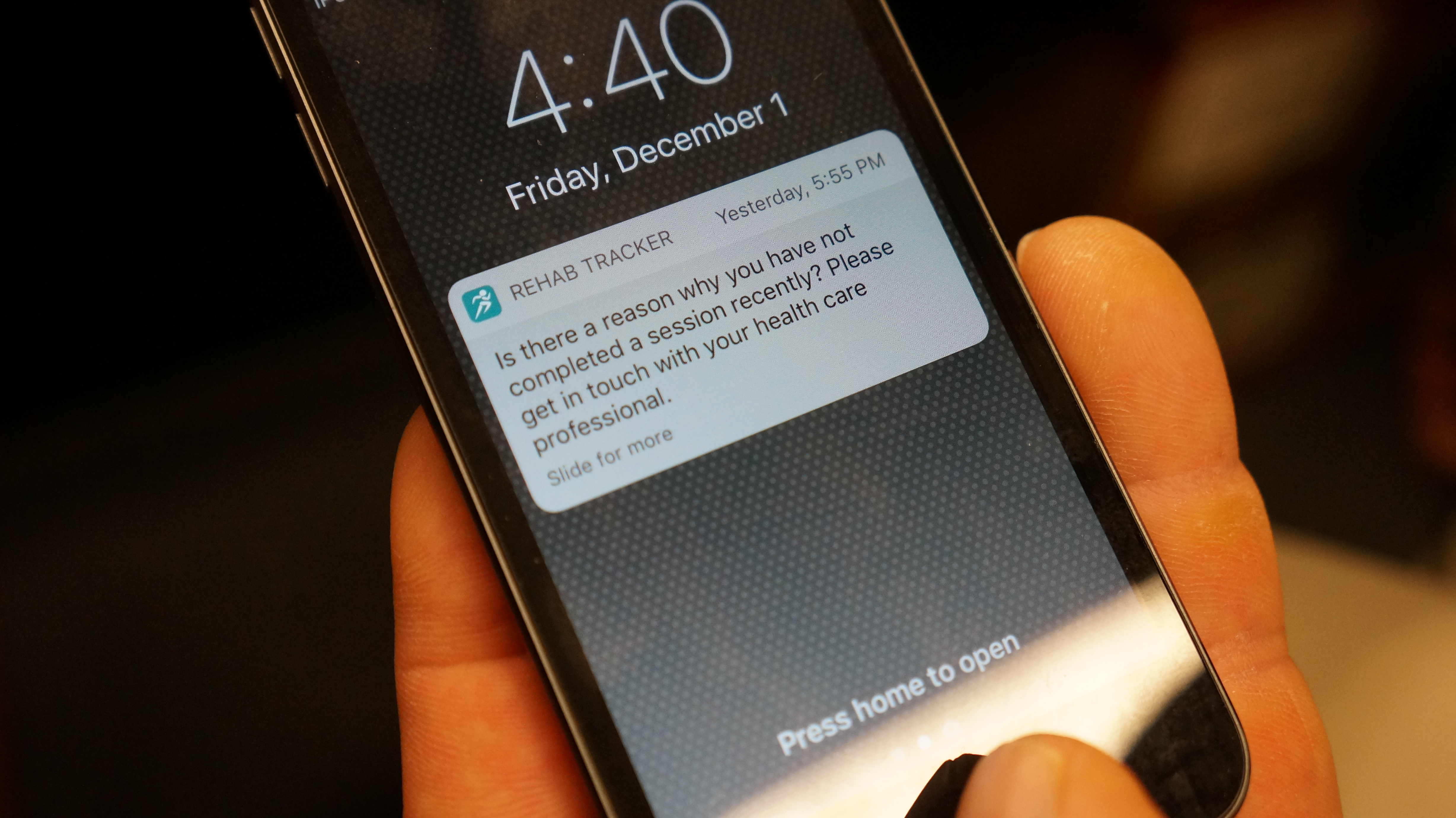
UVM professor and researcher Christian Skalka, Ph.D. demonstrates how RehabTracker out-of-compliance notifications may appear on patients' phones.
In patients who have suffered a traumatic knee injury, a successful return to the skeletal muscle function they had prior to injury is difficult. The injury and surgical repair cause them to be very inactive, causing their muscle to shrink, or atrophy, and weaken. Physical therapy prior to surgery is often not physically feasible, and post-operative strengthening exercises generally don’t start for several weeks after the procedure. This muscle atrophy and weakness increases the risk of re-injury and developing knee osteoarthritis in the future.
Over the years, care providers have sought to overcome these hurdles through the use of neuromuscular electrical stimulation (NMES) devices, which contract muscles through the use of electrical stimulation in a manner similar to that generated by normal physical exercise. While the devices have been successfully used in clinical settings to reduce muscle atrophy and improve muscle contraction in post-surgical patients, they are typically not used prior to surgery and are not regularly available to pre- and post-op patients for at-home use. Enter University of Vermont researchers Michael Toth, Ph.D., and Christian Skalka, Ph.D.
In early 2017, the two faculty members – a professor of medicine and associate professor of computer science, respectively – were awarded one of two inaugural UVM Biomedical Engineering (BME) Pilot Research Program grants for their project, “Cyber-physical system innovations to monitor and improve compliance with at-home neuromuscular rehabilitation.” Through the project, Toth and Skalka have worked to create a cyber-physical electrical stimulation system that acts as a bridge therapy for patients immediately post-injury and in the time between surgery and the start of physical therapy.
Their idea is simple in concept– a Bluetooth-enabled personal NMES device that collects detailed data about device usage in real-time and sends these data to a mobile phone app. On the other end of the data stream, a backend server hosts an automated compliance analysis algorithm that analyzes the data and sends the care provider and the patient either “in” or “out of compliance” messages.
“The use of a mobile app pushes the requirement of internet connectivity to the smartphone hosting the app, and therefore reduces the complexity and power requirements of the device, and eases automated data transfer to the care provider,” says Skalka.
If successful, the device will be the first of its kind to provide real-time monitoring of at-home rehabilitation using NMES.
The project grew out of a collaboration between Toth and UVM Professor of Orthopaedics and Rehabilitation Bruce Beynnon, Ph.D., who are currently conducting a clinical trial testing the utility of NMES in patients with traumatic knee injury under a two-year grant from the National Institute of Arthritis and Musculoskeletal and Skin Disease. While conducting the study, Toth began to consider issues of compliance with prescribed at-home therapies and took the first steps toward developing his and Skalka’s new Bluetooth-enabled NMES device prototype. Through a UVM Senior Experience in Engineering (SEED) project directed by Toth in collaboration with Jeff Frolik, Ph.D., UVM professor of engineering and mathematical sciences, the initial building blocks of Skalka and Toth’s current project were put in place and a prototype of an instrumented NMES device was successfully created.
Now, six months into their BME-funded project, Toth and Skalka not only have the hardware piece of their “cyber-physical system” completed, but the iPhone/tablet-compatible mobile app has been completed as well. Supervised by Skalka and using rudimentary code initially written by students in CS275: Mobile Apps and Embedded Devices, a UVM Computer Science course, BME research graduate assistant Tim Stevens and UVM Global Gateway Program student Chia-Chun Chao, have created a functional app, currently called RehabTracker with a patient interface that provides users with graphical reporting of their recent device usage and notifies them if they are in or out of compliance with their provider-prescribed NMES program. They’ve also developed the code necessary to analyze the data being sent from the device to the app and a web interface for providers to review device usage and program compliance.
The in or out of compliance messages patients will receive were initially created by Toth and then honed by UVM Professor of Nutrition and Food Sciences Jean Harvey, Ph.D., R.D., who is an expert in digital communications with patients in behavioral weight control and lifestyle modification programs.
In early 2018, the project is expected to enter its next phase with proof-of-principle testing of the system in a cohort of healthy, young patients who have suffered an anterior cruciate ligament (ACL) rupture and are scheduled to receive reconstructive surgery. Toth and Skalka hope the tests will provide evidence that the system successfully tracks patient device usage, transmits and interprets the data in an effective way, and allows innovative clinician-patient communication about compliance with prescribed rehab programs.
If successful, Skalka and Toth will be one step closer to the creation of a new transitional therapy system that could extend the benefits of exercise to those with orthopedic injuries or surgery who otherwise couldn’t participate in rehab. They hope that the system will have wider utility in other populations for whom typical exercise is prohibited or difficult, such as patients with cancer undergoing chemotherapy and those with chronic diseases who experience acute disease exacerbation.